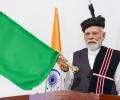
In the last 11 years, India and the world witnessed what he stood for, what he promised and did not deliver, and what he actually stood for and practised without fearing how history would judge him. Modi's tenure has been punctuated with headline-grabbing decisions, symbolic gestures, and stage-managed moments that continue to define his leadership and India's politics, points out Ramesh Menon.

In the meeting, Doval conveyed to Wang that peace and tranquillity in border areas and respect for the Line of Actual Control are essential for return of normalcy in bilateral ties, according to the ministry of external affairs.

The NSA particularly highlighted the need for resolving outstanding issues as quickly as possible and talked about the need for maturity and sincerity in dealing with the issue.
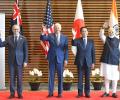
Chinese and Russian warplanes on Tuesday conducted joint air patrols over the Sea of Japan, the East China Sea and the West Pacific Ocean as the leaders of Quad held their in-person summit in Tokyo, in an apparent attempt to send a message of unity between Beijing and Moscow.

India has emerged as a 'major power' by achieving outstanding results in economic development and social governance and its transformation as a stronger, assertive country has made it a 'new geopolitical factor', according to a commentary by a Chinese scholar in a state-run newspaper in Beijing.

The situation along the Line of Actual Control (LAC) in eastern Ladakh is stable but sensitive and not normal, Chief of Army Staff General Upendra Dwivedi said on Tuesday on the dragging military standoff between China and India in the region.

Shringla said that diplomacy is looking at a very changed scenario in terms of how statecraft and relations between countries work in the wake of the pandemic.

'In Eastern Ladakh the Chinese attempted salami slicing.' 'Our response has been superb. Our military has responded magnificently.'
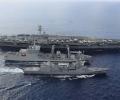
It was for the first time that a Chinese spy ship was detected in Japanese water since a submarine was spotted in 2004. The latest intrusion came less than a week after another Chinese naval vessel sailed near islands at the centre of a Tokyo-Beijing sovereignty dispute in the East China Sea.

Each time an Indian minister visits Arunachal Pradesh, the tinpot Communists in Beijing's Zhongnanhai get worked up and mutter threats.

India and China have made "some progress" in disengagement, External Affairs Minister S Jaishankar said on Sunday, describing it as a "welcome" move which opens up the possibility that other steps could happen.

'With continued focus on votes, upcoming by-polls and purchasing politicians, the political hierarchy has little time for national defence.' 'They would do well to heed a veteran scholar, who says, "There will be war with China in the next few years. The next full scale war will have the involvement of Pakistan and terror elements, insurgents and intelligence assets operating inside India",' warns Lieutenant General Prakash Katoch (retd).

The top diplomats of Quad nations on Friday denounced as "inadmissible" any use or threat of use of nuclear weapons in the Ukraine war and strongly opposed any "unilateral actions" that seek to change the status quo in the South and East China Seas, a region that has witnessed increasing Chinese military offensive.


The Chinese military, on the last day of its largest-ever military exercises to vent out its anger over United States House Speaker Nancy Pelosi's visit to Taiwan, carried out island saturation attack drills in the Taiwan Straits, amid global concerns of a full-scale attack to annex the breakaway island which Beijing claims is part of its territory.

While Modi has spent fewer days abroad than his predecessor (270 days versus Dr Singh's 306), he has travelled more extensively and actively than any other Indian PM.

External Affairs Ministry Spokesperson Raveesh Kumar also talked about the China-Pakistan economic corridor in Pakistan-occupied-Kashmir, asserting that India is 'resolutely opposed' to any actions by other countries to change the status quo in the region.

Pakistan Prime Minister Shehbaz Sharif has called on "brotherly" countries, including Saudi Arabia, to urge India to de-escalate tensions after the Pahalgam terror attack that killed 26 people. Sharif met with ambassadors from Saudi Arabia, the UAE, and Kuwait, reiterating Pakistan's commitment to peace in South Asia. He rejected India's accusations linking Pakistan to the attack, emphasizing Pakistan's own history as a victim of terrorism. The meeting comes amidst heightened tensions between the two countries.

China on Monday said it is planning to allow a small number of foreign students with 'actual needs' who are stuck in their countries for about two years due to its COVID visa bans to return to the country.

Chinese Foreign Minister Wang Yi has said that during his recent visit to India, he "keenly felt" that both sides had agreed to adhere to the leaders' consensus that the two countries are not a threat to each other and handle and manage their differences.

The trigger that led Japan and the Philippines to ink the deal was because of the deteriorating security situation in the South China Sea. China's coast guard increased the frequency and intensity of incursions into Philippine waters, provoking the Philippines to take countermeasures to deter China, explains Dr Rajaram Panda.
Amid a chill in Indo-Pak ties, US Secretary of State Condoleezza Rice and Chinese Foreign Minister Yang Jiechi called up External Affairs Minister Pranab Mukherjee and discussed the situation arising out of Mumbai terror attacks.
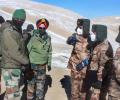
India and China on Tuesday agreed to hold the next round of the Senior Commanders meeting at an early date to achieve complete disengagement from all friction points in eastern Ladakh to create conditions for the restoration of normalcy in bilateral ties.
'What the US appears to be doing is to force India to be "the buyer of last resort", on whom their products can be dumped, 1.4 billion people have to eat something, so why not eat American corn?' 'What is exercising the Trump lot is the fact that most of the farms are in solidly Republican Midwestern states: Illinois, Indiana, Kansas, Michigan, Minnesota, Missouri, Nebraska, North Dakota, Ohio, South Dakota, Wisconsin,' points out Rajeev Srinivasan.
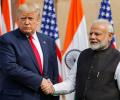
The China threat continues to resonate in the strategic partnership between India and the USA, points out Rup Narayan Das.
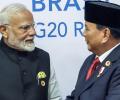
India is trying hard to erase Indonesia's wariness about New Delhi, building security cooperation in the Indian Ocean and Pacific Ocean. If Indonesia decides to buy the Brahmos missile, it would further strengthen relations between the world's most populous nation and the most populous Islamic country.

His trip to Moscow comes days after Defence Minister Rajnath Singh visited the Russian capital to attend a meeting of the defence ministers of the eight-nation SCO of which both India and China are members.

Nine Chinese engineers were among 13 people killed on Wednesday when a bus carrying construction workers in northwest Pakistan's mountainous region was "attacked", according to officials and eyewitnesses.

The two sides are also likely to firm up a currency swap framework and seal several other agreements including one on debt restructuring following talks between Modi and Sri Lankan President Anura Kumara Disanayaka on April 5, people familiar with the matter said.
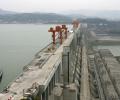
China has approved the construction of the world's largest dam on the Brahmaputra River in Tibet, close to the Indian border. The USD 137 billion project, which is expected to dwarf even China's own Three Gorges Dam, has raised concerns in India and Bangladesh, the downstream riparian states. Concerns in India are centered around China's potential to control water flow, potentially enabling the release of large amounts of water to flood border areas in times of hostilities. The dam is part of China's 14th Five-Year Plan, and the Chinese government claims that the project is safe and prioritizes ecological protection.
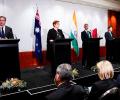
The meeting to be presided over by External Affairs Minister S Jaishankar will be attended by US Secretary of State Antony Blinken, Japanese Foreign Minister Yoshimasa Hayashi and Australia's Penny Wong.
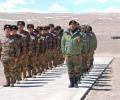
There was no comment from the Indian side on the statement made by the Chinese defence ministry spokesperson Colonel Wu Qian, and carried by China's official media.

Wang Qi, 77, was received by his close Chinese relatives, besides officials of the China's Ministry of Foreign Affairs and Indian embassy when he arrived in Beijing along with his son, daughter-in-law and grand daughter from Delhi-Beijing flight.

In their first structured bilateral talks in nearly five years, Prime Minister Narendra Modi and Chinese President Xi Jinping Wednesday agreed that India and China can have a 'peaceful and stable' relationship by displaying maturity and mutual respect and endorsed the pact on the resolution of the dragging eastern Ladakh border row.

Elon Musk-led Tesla Inc is yet to express interest in India's flagship scheme to attract global investment in electric vehicle (EV) manufacturing, said Union Minister for Heavy Industries H D Kumaraswamy on Monday. In contrast, multiple global automobile giants -- such as Mercedes-Benz, koda Auto Volkswagen, Hyundai Motor, and Kia Motors -- are keen to participate, the minister noted.

China, which has territorial disputes with many countries in the strategic Indo-Pacific region, has been opposing the Quad alliance since its formation.

The external affairs minister reiterated India's position on Afghanistan and highlighted its humanitarian support to the war-torn country, including the supply of wheat, medicines, vaccines and clothing.

China on Thursday said it 'firmly opposes' the United States recognition of Arunachal Pradesh as part of Indian territory and affirmed that Washington, DC has nothing to do with the India-China border dispute.

India would not be seen to be anything but rude with the Pakistanis. In the big picture, who is the bigger adversary right now? Who is the bigger pain in the neck? And who is it that is keeping more than 3,000 km of our borders active, throwing our military posture and deployments into imbalance? asks Shekhar Gupta.
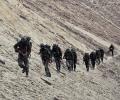
The government needs to answer the critical question of whether it has accepted any restrictions on its infrastructure creation activities, asserts Ajai Shukla.
